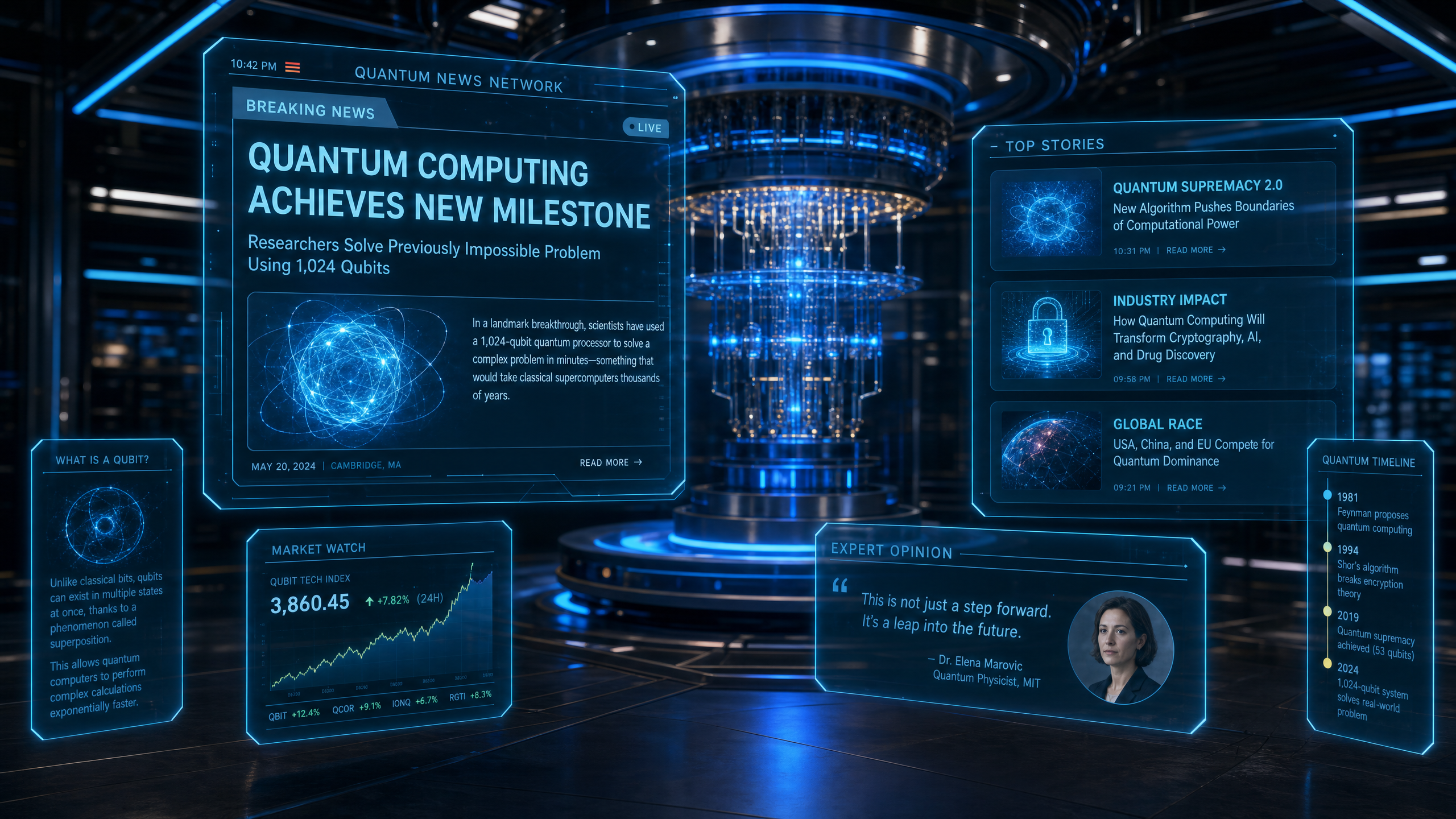




Right now, the way we keep our information safe on the internet uses special math puzzles that are hard for regular computers to solve. But new kinds of super-powerful computers called quantum computers can solve these puzzles much faster, which could make our secrets easier to crack. So, scientists are working on new ways to protect our information that even quantum computers can't break.
Read full article →Quantum eMotion made a new tool called eShield-Q to help keep computer secrets safe. It protects important information from being stolen or hacked, which is very important as more things happen online. This helps people and companies stay safe in the digital world.
Read full article →Michaela Eichinger works with quantum computers, which are super-powerful machines that can solve tricky problems faster than regular computers. She talks about how people need to work together and share ideas to make these machines better and help them grow. This is important because quantum computers can help us learn new things and solve big challenges in the future.
Read full article →Quantum eMotion made a new tool called eShield-Q to keep secret codes safe while computers are working. This is important because bad people and new powerful computers might try to steal these secrets. Think of it like a special shield that protects your treasure while you’re using it.
Read full article →Maryland is putting a lot of money into special computers called quantum computers, which can solve big problems much faster than regular ones. This helps the state create new jobs and become a leader in this cool technology. It’s like building a super-fast brain to help people do amazing things in the future!
Read full article →TreQ has made a special new computer called a quantum testbed in Oxfordshire, UK. This computer can try out different parts from many companies, like building with LEGO blocks that fit together easily. It helps scientists learn and create better quantum computers, which could solve big problems faster than regular computers.
Read full article →Some smart people made a special computer called a quantum computer work faster by using clever software. This software helps set up and check 21 tiny parts called qubits, which are like super tiny switches that can do lots of things at once. Making these computers ready quicker is important because it helps scientists solve really hard problems faster in the future!
Read full article →Some smart people made a tiny special computer called a quantum computer work by itself without much help. This computer uses tiny spots called nitrogen-vacancy centers, which are like little helpers inside diamonds, to do tricky math faster. Making it start up on its own is important because it helps scientists use these cool computers more easily in the future.
Read full article →Scientists used a special kind of computer called a quantum computer to watch how tiny particles called spins move in a line. This is important because it helps us understand how things like electricity work in very small spaces. It’s like using a super-smart robot to explore how a tiny train of magnets travels along a track!
Read full article →IBM and Dallara are working together to use super-smart computers to help design faster race cars. They use special computer programs that can learn and solve tricky problems, like how air moves around a car. This helps make racing cars better and faster, which is exciting for people who love speed and technology!
Read full article →A company called QuantumDiamonds has set up a special new machine in Taiwan that can help find tiny problems in computer parts. This machine uses a special kind of science called quantum sensing, which helps it see things much more clearly than normal tools. This is important because it can help make computers work better and faster in the future.
Read full article →A group called the Chicago Quantum Exchange made a plan to help train lots of people for new jobs with quantum computers, which are super-powerful computers of the future. This is important because many new jobs will open up, and they want to make sure people in the Midwest are ready to take them. It’s like getting a team ready to play a big game so everyone can win!
Read full article →A virus called hantavirus made some people on a cruise ship very sick. Scientists are trying to figure out how the virus spread because it’s new and tricky. This is important so they can help the people on the ship and stop the virus from spreading to others.
Read full article →Scientists think they might have found a lost Maya city called Sac Balam. The way the buildings and land look is just like old stories say. Finding this city helps us learn more about how people lived a long time ago.
Read full article →A big whale named Timmy got stuck on the beach in Germany six weeks ago. Scientists were very worried because he was very sick and might have died. This is important because it helps people learn how to help whales in trouble.
Read full article →Gravity is the force that pulls things together, like when you drop a ball, it falls to the ground. Scientists tested a rule about gravity called the "inverse square law" by looking at huge groups of galaxies very far away. They found that this rule works even across these giant distances, helping us understand how the universe holds itself together.
Read full article →Shirley Meng is a scientist who works on making better batteries to help the Earth stay clean. She moved to Singapore because the rules in the U.S. made it harder for her to do this important work. Her goal is to help stop pollution and protect the planet for everyone.
Read full article →Scientists used special tools to see deep underground by checking how rocks carry electricity. This helped them find pieces of an old continent that used to be part of the United States. Knowing this is important because it can help us find valuable minerals and keep power grids safe.
Read full article →Scientists made tiny tools that can watch the brain when it has sudden bursts called "spikes." These spikes confuse the brain cells that help us think. Knowing when a spike will happen, even just one second before, can help doctors take better care of people with epilepsy.
Read full article →Scientists used smart computer programs called AI to help make a tiny living thing, a bacterium, that is missing one building block it usually needs. This is like making a new recipe with different ingredients to create special proteins that could help doctors and invent new medicines. It matters because it might help us make better medicines and tools to keep people healthy.
Read full article →A smart computer program can now help doctors figure out what’s wrong with sick patients, even when things are very busy and fast, like in an emergency room. This is important because it can help doctors make better and quicker choices to take care of people. It’s like having a very fast and smart helper who knows a lot about medicine.
Read full article →Deepfakes are fake pictures and videos that look real, made by computers. Hany Farid is a scientist who creates special tools to find these fake images. Now, he is working hard to stop new computer tricks that make deepfakes even trickier to spot.
Read full article →QuantX Labs has announced that a subsystem payload of TEMPO, its compact optical atomic clock, is now in orbit following a successful launch on March 30, 2026, via the SpaceX Transporter-16 mission. Developed in partnership with the Institute for Photonics and Advanced Sensing (IPAS) at Adelaide Uni
Read full article →Quantum Art, an Israeli-based developer of full-stack trapped-ion quantum computers, has extended its Series A financing to $140 million. Led by Bedford Ridge Capital, the extension follows an initial $100 million round announced in December 2025 and includes new participation from Hudson Bay Capita
Read full article →IQM Quantum Computers has reached an agreement with TOYO Corporation for the sale and deployment of an IQM Radiance 20-qubit system. This transaction marks the first instance of an enterprise-purchased quantum computer deployment in Japan. The full-stack superconducting system is scheduled for deliv
Read full article →Hawking’s signature prediction may prevent vexing singularities from forming
Read full article →Before antiretroviral drugs reached South Africa, high death toll shaped immune system genes
Read full article →Pennsylvania has launched the Keystone AI + Quantum Factory, a first-of-its-kind statewide innovation network designed to transition academic research into industrial applications. This historic collaboration aligns the Commonwealth's seven R1 research universities—Carnegie Mellon, Drexel, Lehigh, P
Read full article →Quantinuum LLC, a quantum hardware company majority owned by Honeywell, has filed a confidential S-1 form on February 17, 2026 with the U.S. Security and Exchange Commission (SEC) for a proposed Initial Public Offering (IPO) of Quantinuum’s common stock. This detailed registration statement will un
Read full article →Dismissal of the National Science Board is widely seen as latest move to erase NSF’s independence
Read full article →Three RIKEN researchers have demonstrated a way to stop problematic "dark modes" from squelching intriguing effects in quantum systems. This advance could help with the development of more versatile quantum devices that can be used to control the storage and transmission of quantum information. The
Read full article →A novel approach for realizing the one-way quantum synchronization of phonons has been proposed by three theoretical physicists at RIKEN. Importantly, this method is remarkably resilient against practical challenges such as imperfections and environmental noise. Their paper, "Nonreciprocal quantum s
Read full article →Agency’s temporary director says Morbidity and Mortality Weekly Report needs external reviewers
Read full article →As SpaceX readies its latest megarocket, engineer Stephen Whitmore explains why atmospheric reentry pushes materials to their limits
Read full article →Experts say the lapse highlights that even new measures to control access did not safeguard deidentified patient information
Read full article →Flood of proposals to European Research Council—perhaps unleashed by AI—means unsuccessful applicants must wait longer to reapply
Read full article →The most demanding calculations in quantum chemistry can now be solved with graphics processing unit (GPU) supercomputers. A recently published study shows that software adapted to use GPU hardware can provide not just speed, but also the accuracy needed to solve complex chemistry problems. The work
Read full article →Semiconductor spin qubits are a promising candidate for the building blocks of next-generation quantum computers due to their high potential for integration and compatibility with existing semiconductor technologies. Qubits—like the 0s and 1s of a traditional computer—serve as a basic unit of inform
Read full article →Quantum computers, devices that process information leveraging quantum mechanical effects, could tackle some tasks that are difficult or impossible to solve using classical computers. These systems represent data as qubits, units of information that can exist in multiple states at once, unlike the b
Read full article →Researchers in the US and Germany have unveiled a theoretical blueprint for an atomic clock driven by a highly synchronized laser, where atoms work in concert rather than independently. Publishing their results in Physical Review Letters, Jarrod Reilly at the University of Colorado, Simon Jäger at t
Read full article →Long-awaited policy shift could ease barriers for scientists who study the drug
Read full article →It was a head-spinning discovery. In 2018, researchers in Japan claimed to find concrete evidence of an elusive particle, a Majorana fermion, in a quantum spin liquid called ruthenium trichloride. Majoranas are highly sought-after by quantum materials scientists because when a pair are localized, or
Read full article →A new method developed at LMU overcomes fundamental resolution limits and may provide insights into high-temperature superconductivity. Physicist Dr. Sebastian Paeckel has developed a method that can be used to calculate spectral functions of complex quantum systems much more precisely than was poss
Read full article →When you throw a ball in the air, the equations of classical physics will tell you exactly what path the ball will take as it falls, and when and where it will land. But if you were to squeeze that same ball down to the size of an atom or smaller, it would behave in ways beyond anything that classic
Read full article →A tiny discrepancy in particle physics has loomed for decades as an exciting possible crack in one of science's most successful theories, hinting at unknown forces or quantum objects. Now, an international team led by a Penn State physicist has published the most precise study yet to reveal the disc
Read full article →Only about 5% of the universe is composed of normal matter that we can directly observe, while the remaining 95% is widely believed to consist of dark matter and dark energy. Paradoxically, however, the nature of these dark components remains unknown. Is this due to limitations in our observational
Read full article →As long as there's been an internet, there's been a way to hack it. Scientists have spent decades imagining a different kind of network, one where the laws of physics make eavesdropping physically impossible, not just technically difficult. They call that dream a quantum internet.
Read full article →Researchers from the University of Twente and Harvard University have developed a new way to generate ultraviolet (UV) light on a photonic chip at power levels high enough for real-world use. For the first time, the technique produces milliwatt-level UV light on a chip. It is an important step for q
Read full article →Researchers have discovered a new way to tune the quantum properties of tiny defects in diamond—by gently stretching or compressing the crystal. These findings could pave the way for next-generation sensors that can detect pressure, temperature, and other physical changes with unprecedented precisio
Read full article →A quantum spin liquid is a phase of matter in which the magnetic moments in a material do not align or freeze, even at temperatures close to absolute zero (i.e., at 0 K). The experimental realization of this highly dynamic state could have important implications for the development of quantum comput
Read full article →The cosmological constant is the mathematical description of the energy that drives the ever-accelerating expansion of the cosmos. It's also the source of one of the most enduring and confounding problems in modern physics.
Read full article →A new theoretical study finds shorter laser pulses achieve higher quantum efficiency for photoemission from a solid surface without increasing power or intensity. Using light to knock electrons loose from a surface—known as photoemission—may soon be achievable more easily in smaller labs with smalle
Read full article →A joint theoretical study by the University of Innsbruck and Zhejiang University has uncovered the microscopic origin of a striking quantum phenomenon: a periodically driven gas of ultracold atoms that simply refuses to heat up, defying classical expectations.
Read full article →Superconducting qubits—bits of quantum information—have been widely considered a promising technology for moving quantum computing forward. But there's still much work to be done before they can be brought out of a near absolute zero temperature environment. The lab of Professor Hong Tang has recent
Read full article →Few concepts in physics are as familiar, yet as enigmatic, as time. In Einstein's theory of relativity, time is not absolute: its passage depends on motion and gravity. But when combined with quantum physics, this relativistic form of time becomes even more counterintuitive.
Read full article →Two independent research teams have each demonstrated collisional quantum gates using fermionic atoms: a long-sought milestone in quantum computing where logic operations are performed through the direct physical overlap of atoms, rather than forcing them into fragile, highly excited states.
Read full article →In the quirky quantum world, particles can be affected by forces that they never directly encounter. A classic example is the Aharonov–Bohm (AB) effect, where electrons are affected by a magnetic field, despite not passing through it. Although predicted in 1959, it took more than two decades to conf
Read full article →Researchers in the UC Santa Barbara Materials Department have uncovered the elusive quantum mechanism by which energetic electrons break chemical bonds inside microelectronic devices—a detrimental process that slowly degrades performance over time. The discovery, published as an Editors' Suggestion
Read full article →A new study published in Nature Communications has shown that in the asymptotic limit, extracting the maximum possible work from many copies of a quantum system does not require knowing exactly what state that system is in.
Read full article →A joint research team led by Professor Park Kyoung-Duck and Associate Director Suh Yung Doug of the Center for Multidimensional Carbon Materials within the Institute for Basic Science (IBS) has succeeded in realizing a high-efficiency quantum light source that emits bright lights even at room temper
Read full article →An AI model informed by calculations from a quantum computer can better predict the behavior of a complex physical system over the long term than current best models that use only conventional computers, according to a new study led by UCL (University College London) researchers. The findings, publi
Read full article →A new Bar-Ilan University study points to a major advance in quantum information processing, demonstrating a way to send, manipulate, and measure quantum information across many frequency channels simultaneously, rather than one at a time. The study was recently published in the journal Science Adva
Read full article →